Antique Ethiopian Wood Headrest
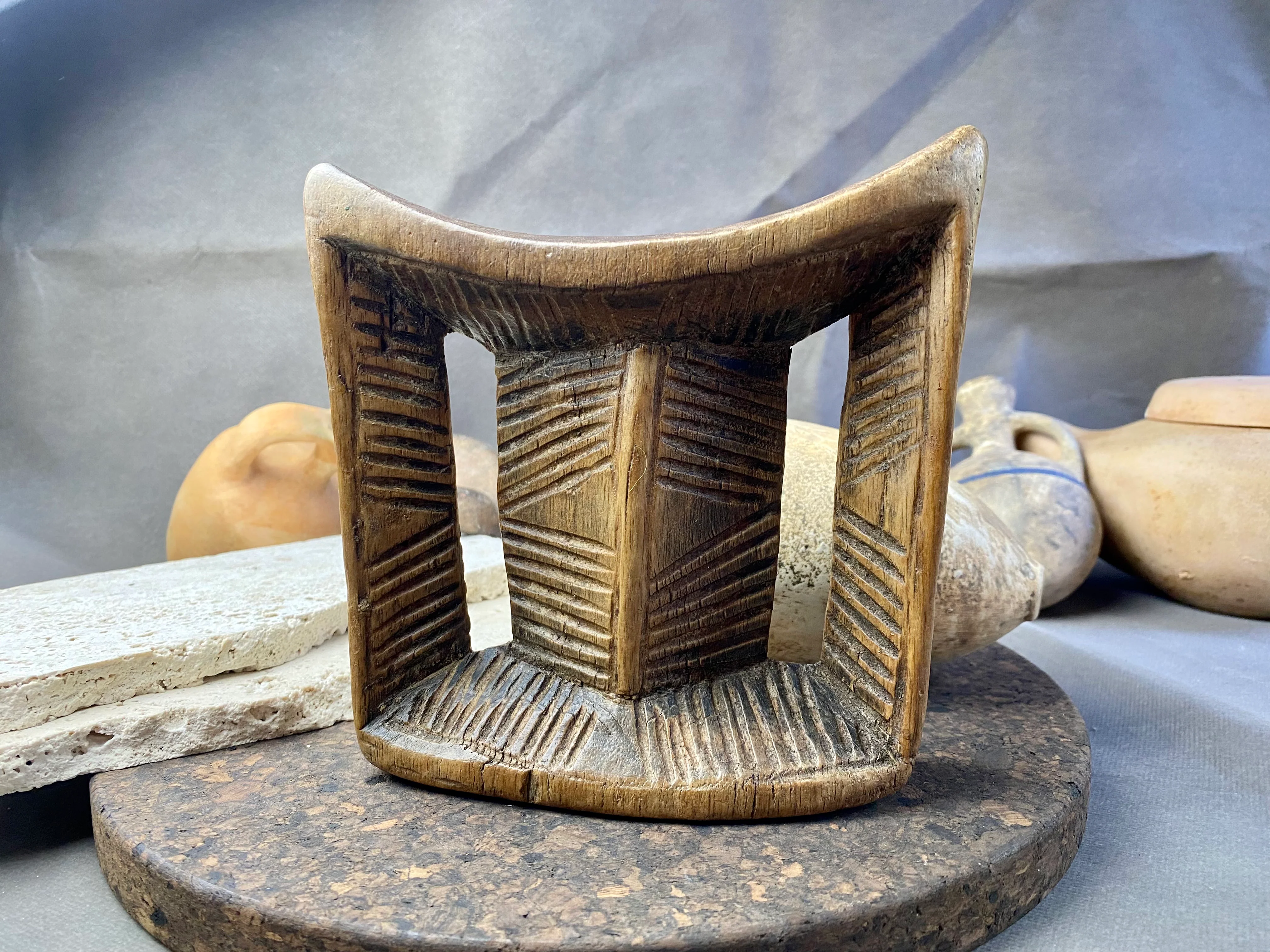
Old Oromo tribe wooden headrest from Ethiopia. Carved from a single piece of wood. Pre 1950. The patina and wear on this piece are appropriate to its age. In particular, note that the upper surface is darkened from use and the leading front edge is both lower than the rear edge and is also smooth from use.
Measurements: height 13 - 16 cm (5-7"), width 15.5 cm (6")
Hand carved wood headrests are used throughout Africa as pillows, to preserve the elaborate hairstyle of its owner during sleep.
Personal objects, headrests support the head by cradling it along the jawline, elevating it from the ground. While some regions of central and southern Africa associate headrests with dreaming and divination, they are purely practical in eastern African. Ergonomically, they align the spine, while functionally, they protect intricate hairstyles from dust or from being flattened. Hairstyles, which can take hours to create, are not simply elements of beautification, but serve as the visual representation for their wearer’s social status, age, rank, and gender. The personal nature of the headrest is reflected in the vocabulary used to describe them in two of Ethiopia’s most commonly spoken languages. In Amharic, they are known as yagertera (“pillow of my land”), while in Oromiffaa, they are called boraati (“tomorrow-you”). (Moreno 2015, 194) Even after the end of their useful life, headrests retain the traces of their owners; several examples in the Metropolitan’s collections have a dark sheen on the upper platform and sides, the result of the wood becoming imbued with butter-based hair dressings (käbbe) and other materials used to shape and condition the hair. - The Met Museum
Original: $127.06
-65%$127.06
$44.47Product Information
Product Information
Shipping & Returns
Shipping & Returns
Description
Old Oromo tribe wooden headrest from Ethiopia. Carved from a single piece of wood. Pre 1950. The patina and wear on this piece are appropriate to its age. In particular, note that the upper surface is darkened from use and the leading front edge is both lower than the rear edge and is also smooth from use.
Measurements: height 13 - 16 cm (5-7"), width 15.5 cm (6")
Hand carved wood headrests are used throughout Africa as pillows, to preserve the elaborate hairstyle of its owner during sleep.
Personal objects, headrests support the head by cradling it along the jawline, elevating it from the ground. While some regions of central and southern Africa associate headrests with dreaming and divination, they are purely practical in eastern African. Ergonomically, they align the spine, while functionally, they protect intricate hairstyles from dust or from being flattened. Hairstyles, which can take hours to create, are not simply elements of beautification, but serve as the visual representation for their wearer’s social status, age, rank, and gender. The personal nature of the headrest is reflected in the vocabulary used to describe them in two of Ethiopia’s most commonly spoken languages. In Amharic, they are known as yagertera (“pillow of my land”), while in Oromiffaa, they are called boraati (“tomorrow-you”). (Moreno 2015, 194) Even after the end of their useful life, headrests retain the traces of their owners; several examples in the Metropolitan’s collections have a dark sheen on the upper platform and sides, the result of the wood becoming imbued with butter-based hair dressings (käbbe) and other materials used to shape and condition the hair. - The Met Museum